




Business Portfolio
• The Fixed Income Desk position has a low risk, as the portfolio is composed entirely of government paper, 99% of which is variable rate and 1% is discount.
Money Desk
(million pesos)
The derivative position for business purposes is closed (Economic Coverage).
Podition Options and Business Swap - December 2018
Brand to Market | |||||
Business Derivaties (millions pesos) | Short Position | Long Position | Total | Net Premiums | Hedging |
| Rate Options | -6.831 | 6.831 | 0.00 | 2.4 | Economic |
| Currency Options | -0.001 | 0.001 | 0.00 | 0.0 | |
Total Business Derivatives | -6.8 | 6.8 | 0.00 | 2.4 | |
Brand to Market | |||||
Business Swap (million pesos) | To receive | To hand over | Total | Credit Line | Hedging |
| Intereset Rate Swaps Customers | 1,143.8 | 1,039.2 | 104.6 | 688.07 | Economic |
Intereset Rate Swaps Banks | 1,039.2 | 1,071.1 | -31.9 | ||
Total Business Swap | 2,183.0 | 2,110.3 | 72.7 | ||

Liquidity Risk
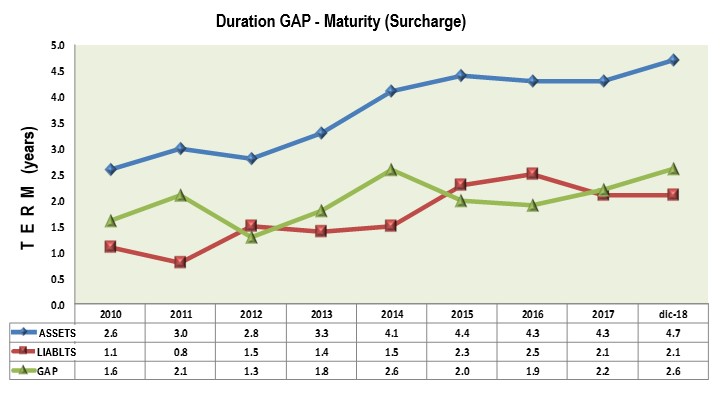
Maturity Profile - Surcharge
Maturities: medium and long term assets financed with short term. Upward sensitivity in surcharges.

Banking Portfolio. GAP project lasting 2.6 years.

Operational risk
Operational risk management in Bancomext establishes, through its manuals, the guidelines and policies that will govern the activities inherent to the function of Non-Discretionary Risks and Non-Quantifiable Risks management, as well as the use of the methodologies that will be applied within the Institution to identify, measure, monitor, control, inform and reveal the aforementioned risks.
Method to determine the capital requirement by Operational Risk
The institution uses the National Banking and Securities Commission (CNBV) Basic Indicator Method to estimate the capital requirement by operational risk.
In the fourth quarter, the requirement was set at 96% of the capital tolerance level.
| Capital Requirement by Operational Risk (RCRO) | Assets Subject to Operational Risk (ASRO) |
| 964 | 12,049 |
The management of quantifiable non-discretionary risks aims to identify, measure, monitor, limit, control and report the operational, technological and legal risks, associated with the Institution’s processes, to identify the concentration levels, operating efficiency, and economic impact of said processes.
Likewise, in order to identify the quantifiable risks and determine their average exposure value, by type of event and line of business, the results are shown below for the period from January 2008 to December 2018 according to the regulatory taxonomy:
By Type of Event, Ongoing, Delivery, and Process Management, 88% of the frequency, and 93% of the severity are concentrated.

Legal Risk
The legal risk is limited, given the sufficiency of reserves for the contingencies recognized, in accordance with the procedural stage of each trial and the legal expectations.

Technological Risk
A Technological Profile is developed that considers the criticality and obsolescence of the Institutional Applications, locating them in a Technological Risk Map that considers the frequency and severity to determine their level of exposure. Likewise, indicators of Technology and Information Services Availability and Security are used. The behavior of the events detected in the indicators has fallen within the established compliance parameters.
Risk Dashboards
Risk Profile
Evaluates different indicators and expresses the level of risk, with respect to the Business areas.

Risk Profile Map
The Risk Profile is characterized as follows:
The Expected Loss has remained low as a percentage of the Business Portfolio balance. The delinquency is similar to that of commercial banks for this credit segment. During the 2012-2015 period, the Institution had the lowest delinquency rate in the Mexican banking system.
Credit risk is controlled through sectored portfolios and good credit quality, which tend to a lower concentration and a longer-term.
The growth of the loan portfolio has been ordered in terms of concentration levels by economic group, sector, and region, achieving a greater direct and indirect credit spread.
The Institution has a solid Corporate Governance structure, an adequate risk management strategy with policies and procedures, in compliance with regulatory and banking practices, and a financial discipline that builds confidence in national and international markets.
The bank's capital usage corresponds primarily to credit operations (63%) and market (7%), to support the risk of funding long-term credit operations.
The Institution has a sufficient capitalization to sustain its medium and long term Annual Business Plans, and, where appropriate, partially absorb adverse impacts stemming from the current financial environment.