

Since the implementation of the management framework called Environmental and Social Risk Management System (SARAS) of Bancomext in 2017, for the credit process of first-tier operations, the Institution has strengthened, on the one hand, the evaluation and management of this type of risks by taking into account the review of environmental and social aspects (AyS for its acronym in Spanish) pursuant to the compliance of national laws and, on the other hand, it has performed the analysis of investment projects in accordance with the Equator Principles and Performance Standards in Environmental and Social Sustainability of the International Financial Corporation (IFC).
This methodology allows to keep a categorization registry based on the AyS, risk identified by the evaluations carried out on first-tier operations:

In July 2021, Bancomext issued for the first time in the international market a topic-based sustainability bond. This issuance represented a watershed, given that it reaffirms the commitment of Bancomext not only to evaluate and manage AyS risks, but also to start by identifying potential environmental and social benefits of the projects, following the trend of international financial institutions.
For this first issuance, the areas of Business and UGAS (acronym in Spanish for: Environmental and Social Management Unit) worked jointly to identify, based on the Bank’s [Bancomext] sectorial approach, the various eligibility criteria that could be selected to consolidate a robust and comprehensive Sustainable Framework.
Thanks to this, the SARAS methodology was strengthened, given that new policies and a new format were included in the credit origination stage. Based on these inclusions, one can check the companies that willingly want to provide information on any policy or practice in terms of sustainability.
In the future that can be foreseen in the Bank’s portfolio, this effort will allow, among other things, to have overall statistics on how many companies are adding some type of sustainability policy to their operation and/or management; what type of actions are being carried out, and whether the results of these policies are being measure or reported.
The issuance had a favorable second-party opinion (SPO), carried out by ISS, which concluded that the Framework complies with the criteria defined by the ICMA (International Capital Market Association) for green, social and sustainability bonds, as well as with the alignment and significant contribution to the SDG of the United Nations 2030 Agenda. The framework as well as the SPO can be consulted on the official webpage: https://www.bancomext.com/conoce-bancomext/bono-sustentable
This way, the Bank is aligning with and contributing to principles from various international initiatives to mitigate global warming and comply with the institutional commitments, assumed with other international Banks, as well as with the progress made in the financial sector’s 17 Sustainable Development Goals (SDG). This is considering that one of the main elements and premises of the initiatives is incorporating, reviewing and documenting environmental and social aspects that may allow measuring and reporting potential financial risks as well as topic-based issuances: green, social and/or sustainable.
The following guiding principles are reaffirmed for the definition of SARAS, its policies and compliance guidelines in terms of environmental and social laws.


Results of SARAS
The historical record of the companies and projects evaluated from 2017 to the end of 2021 is made up of 803 operations. These are classified as follows:

Environmental and social evaluations carried out from the beginning of SARAS to December 31st, 2021, totaled 803 sheets issued. Of these, 3.24% are risk category A, 50.19% B and 46.58% C (Chart 1). During the COVID-19 pandemic (April 2020 to December 2021) a total of 386 evaluation sheets were issued, mainly from the sectors of tourism, industrial facilities, and, to a lesser extent, from the sectors of: metal products, automotive, distributors and transportation and logistics. It is relevant to mention that, throughout 2021, operations were identified regarding three sectors that had not been previously evaluated: cement industry, construction materials and maritime transport services.

Chart 1. Evaluations by risk category
Of the cumulative total, the number of operations carried out by UGAS (Environmental and Social Management Unit) in 2021 reached 146 evaluation sheets, representing half of the operations registered, compared to 2020.

Chart 2. Total evaluations distributed by year and risk category
It is worth mentioning that, as a consequence of the COVID-19 pandemic, in the last two years an important number of evaluated operations was carried out, mainly due to rescheduling and restructuring made by borrowers. To a lesser extent, new operations and/or investment projects were registered. As can be observed on the previous chart, a spike in operations was recorded in 2020, which was the year when the pandemic began in Mexico; from that moment on, some industries were affected by the temporary suspension of activities.
Benefits of SARAS
- Portfolio Management, follow-up and monitoring of the level of Environmental and Social (AyS) risk of the borrowers
SARAS allows both managing the portfolio according to the credit’s AyS risk category as well as duly tracking changes in potential risks, in order to suggest action plans and mitigating measures. By 2021, the monitoring of the contractual obligations was carried out through the Supervision platform, as well as through virtual supervision visits, performed on investment projects from the energy sector; and also by reviewing the reports from the construction supervisor from investment projects of the tourism sector. - Leadership and promotion for National Development Banks (BND for its acronym in Spanish)
Bancomext is a reference for the other development banks in Mexico as to the adoption of international good practices when managing environmental and social risks, given that it has a system such as SARAS, acknowledged by commercial banks and by multilateral bodies. Experiences and lessons learned continue to be shared, in order to align the practices of Development Banks in Mexico. - Greater access to International funds
It is more and more common in today’s world for the market itself and the investor trend to demand for ESG criteria to be incorporated in the financing products. Having a system like SARAS allows the Institution to access more and new funds from responsible markets in environmental and social aspects. - Development of “Green or Sustainable Products”
The Institution has a program for Sustainable Building, which promotes in the real estate sector (construction of national infrastructure) the incorporation of voluntary certifications in Mexico, in the design, construction and operation stages, as well as the LEED certification (Leadership in Energy and Environmental Design), endorsed by the worldwide acknowledged US Green Building Council. The Institution will continue promoting the development of new programs to face the environmental and social needs and opportunities that may appear in some sectors and industries, as well as in accordance with the Bancomext mandate and in line with the national priorities. - Alignment with Banks in Mexico and steadfast commitment to sustainability
Bancomext was the first National Development Bank (BND for its acronym in Spanish) to endorse and sign the Sustainability Protocol of the ABM (acronym in Spanish for: Banks of Mexico Association) in December of 2017. This subsequently encouraged the other Development Banks to join the effort. To date, the seven development institutions take part in this effort. - Technical consulting and support for companies in terms of environmental and social laws
In addition to promoting compliance with environmental and social issues among its borrowers or potential customers, the UGAS provides counseling on the corresponding Mexican regulations to those companies that do not have specialized areas. The goal is for companies to comply with their obligations in terms of environmental and social procedures and permits, this way ensuring an orderly operation and gradually promoting the companies’ social and environmental responsibility. - Collaboration and liaison with government agencies
Communication and collaboration channels have been established between authorities and government agencies entitled in terms of regulation and management of environmental and social aspects (SEMARNAT/ Ministry of the Environment and Natural Resources, PROFEPA/ Attorney General’s Office for Environmental Protection, SECTUR/ Ministry of Tourism, SENER/ Ministry of Energy, CONAGUA/ National Water Commission, INAH/ National Institute of Anthropology and History, etc.). These channels have allowed to share experiences oriented towards strengthening the technical capacities of UGAS and Bancomext. - Coordination of institutional campaign, internally and externally
In collaboration with the Bank’s Coordination Unit of the Institutional Program for Social Responsibility, a Work Plan has been put together to define the following guiding principles:
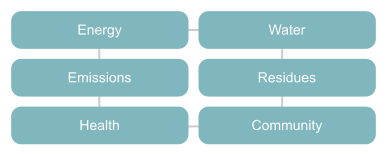
The collaboration with the area is carried out by disseminating infographics and links with interesting contents on climate change and environmental impact. These materials seek to further environmental education and foster a culture of environmental responsibility within the Bank, among employees and their families.
In 2021, considering the health measures in light of the COVID-19 pandemic, an Environmental Challenge was carried out, voluntary and virtual, whose main objective was to encourage employees to become, starting at home, Agents of Change against climate change.