
2016 Annual Report
Boosting Capital Formation And Productivity In Mexico
Financial Statements Download
Boosting Capital Formation And Productivity In Mexico


Mexico is one and many at the same time; it is a multifaceted country in regards to resources...
culture and identity, where many realities with the potential to transform into endless opportunities converge. Its wealth of natural resources, ecosystem diversity, and its more than 60 indigenous languages coexist with a modern infrastructure and cutting-edge technology, great intellectual and creative capabilities, a thriving export dynamic and solid international relations.
Mexico is one and many at the same time; it is a multifaceted country in regards to resources, culture and identity, where many realities with the potential to transform into endless opportunities converge. Its wealth of natural resources, ecosystem diversity, and its more than 60 indigenous languages coexist with a modern infrastructure and cutting-edge technology, great intellectual and creative capabilities, a thriving export dynamic and solid international relations.
Structural reforms in the areas of energy, the financial sector, education, competitiveness and telecommunications were approved in 2013 and 2014. Said reforms will contribute to improve the potential growth of the economy in the medium term by generating more investment and jobs, as well as by incorporating new technologies, reducing production costs and increasing productivity and competitiveness. In particular, the financial reform will allow an increase in financial penetration, the one for energy will attract foreign investment while the one on telecommunications will result in increased competition and lower rates.
In spite of external shocks, México’s GDP grew by 2.3%, with controlled inflation and a rate of exchange that absorbs the volatility of the international environment and the capital flows. This year, total exports amounted to 374 million dollars. Here, stability of oil exports stands out while non-oil exports were less dynamic during most of the year. Among the accomplishments of the BANCOMEXT throughout the year, we can highlight having been the leading institution among development banks in terms of credit granting, with a yearly growth of 26.7%. It is worth mentioning that this growth does not exclusively stem from an increase in the quantity of credits, but also from an expansion of the portfolio to include priority sectors. Furthermore:
With these results, the Bancomext shows its strength and capability to adapt to the circumstances throughout its almost 80 years of existence. It is therefore of vital importance to work day by day as an institution to maintain strong, resilient roots that enable us to take advantage of domestic and international changes that may occur, and to focus our efforts on expanding our horizons toward economies in other parts of the world.
This 2016 Annual Report details activities undertaken during the year, and outlines the most representative numbers and data yielded by the Bancomext.
In this year 2017, we will focus on diversifying our products and services, finding commercial niches, caring for the support of sectors that have been neglected, and accompanying foreign trade stakeholders in achieving a better offer, productivity and competitiveness in their professional activities. We will continue to work with other banking and nonbank financial institutions in expanding the network of investors and commerce stakeholders of Mexico with the purpose of contributing to the internationalization and consolidation of global value chains.
We begin this year 2017 with the solid conviction of experiencing and exploring beyond the horizon, of leaving our comfort zones without forgetting the results that have been obtained throughout time.
2017 looks like a window full of opportunities and, surely, several challenges. Nevertheless, we will stand on the positive results carved through time and will build new roads together to deal with any vicissitudes ahead.
“A” Series Board Members
| Incumbent | Deputy |
| Dr. José Antonio Meade Kuribreña | Mtro. Emilio Suárez Licona |
| Dr. Ildefonso Guajardo Villareal | Lic. María del Rocío Ruíz Chávez |
| Lic. José Eduardo Calzada Rovirosa | Lic. Ricardo Aguilar Castillo |
| Mtra. Claudia Ruíz Massieu Salinas | Mtra. María Eugenia Casar Pérez |
| Lic. Pedro Joaquín Coldwell | Dr. César Emiliano Hernández Ochoa |
| Mtra. Vanessa Rubio Márquez | Dr. Alberto Torres García |
| Lic. Fernando Galindo Favela | Act. Alejandro Sibaja Ríos |
| Mtro. Juan Carlos Baker Pineda | Mtra. Rosaura Virginia Castañeda Ramírez |
| Act. Jesús Alan Elizondo Flores | Lic. Raúl Joel Orozco López |
“B” Series Board Members
| Incumbent | Deputy |
| Act. Juan Pablo Castañon Castañon | Lic. Gustavo Adolfo de Hoyos Walther |
| TBD | Lic. Arturo Pérez Behr |
| Lic. Manuel Herrera Vega | Lic. Enrique Guillén Mondragón |
| Ing. Enrique Solana Sentíes | Lic. Juan Gilberto Marín Quintero |
“B” Series Outside Members There are only Incumbent Outside Members
| Dr. Carlos Leopoldo Sales Sarrapy | C.P.C Jaime Enrique Espinosa de los Monteros |
Commissaries
| Incumbent | Deputy |
| Lic. Rodrigo Alfonso Sánchez Mújica | Lic. Fidel Ramírez Rosales |
| C.P. Carlos Aguilar Villalobos | C.P. Roberto Mateos Cándano |
Secretariat of the Board of Directors
| Secretary | Assistant Secretary |
| Lic. María Elsa Ramírez Martínez | Lic. Jorge Mauricio Di Sciullo Ursini |
Francisco N. González Díaz
Director General(As of February 1, 2017)Jorge Mauricio Di Sciullo Ursini
Deputy Legal and Trust Director GeneralFernando Hoyo Oliver
Deputy Director General of PromotionRebeca Esther Pizano Navarro
Deputy Director General of Corporate BankingMiguel Ángel Ochoa Salas
Deputy Director General of CreditMiguel Siliceo Valdespino
Deputy Director General of FinancesRicardo E. Ochoa Rodríguez
Deputy Director General of Institutional and International AffairsSergio Forte Gómez
Deputy Director General of Investor and Investment Banking RelationsEmeterio Barrientos Romero
Provisional Head at the Office of the Deputy Director of Administration and FinanceVíctor Manuel Jiménez García
Internal Comptrolling DirectorJuan Carlos Álvarez Chavira
Risk-management DirectorMarco Antonio D. Carrera Santa Cruz
Social Communication DirectorJosé Alfonso Medina y Medina
Deputy Director General of Internal AuditSergio Samuel Cancino y León
Head of the Internal Control BodyBanco Nacional de Comercio Exterior, S. N. C. has an Internal Control System that is based on its corporate governance structure, which is composed of the Board of Directors, and of several committees that make decisions on the various aspects of the institution’s operation, such as: integral risk management, credit activities, investment services, human resources and institutional development, IT systems, audit, and internal control; it also relies on a periodic evaluation performed by different levels of supervision which aid in the management of the Institution.
The implementation and continuity of internal control measures is the responsibility of the office of the Director General of the Bancomext, as well as of its governing bodies, and of the executives and employees of the Institution. Compliance, supervision and updating of internal control measures is an ongoing, periodic practice in processes and areas of the Institution.
The Audit Committee is a body that depends on the Board of Directors, which is in charge of evaluating and monitoring the activities of the institution within the framework of the Internal Control System (SCI). It is composed of independent consultants and is assisted by the statutory auditors.
As per the foregoing and pursuant to the General Provisions set forth by the Mexican National Banking and Guarantees Commission (Spanish: Comisión Nacional Bancaria y de Valores) which apply to Credit Institutions, the Bancomext has an Institutional Internal Control Model (MICI), which was updated and approved by the Board of Directors in November of 2016, and includes goals and guidelines with the purpose of establishing a general framework for the personnel of the Institution to implement the SCI in areas and processes under their responsibility. The components of the model are outlined in the following graph.
Objectives
Components
Structure of the Entity
The international environment was characterized by challenges and a complex state of affairs
The international environment in 2016 posed great challenges resulting from the difficulties brought about by a decreasing economic growth and inflation in developed countries, world commerce and investment, as well as a greater political uncertainty and volatility arising from the Brexit and the result of the United States presidential elections.
The international environment in 2016 posed great challenges resulting from the difficulties brought about by a decreasing economic growth and inflation in developed countries, world commerce and investment, as well as a greater political uncertainty and volatility arising from the Brexit and the result of the United States presidential elections.
The USA exhibited weakness in key sectors such as industry and exports. International oil prices, which are still low, in addition to historically high exchange rates, have caused great stress to public finances.
Chinese economy continued being the driver of world growth, although its expansion level at 6.7% was again lower than in the prior year. Before this, the Chinese government accelerated its strategy to lead the country towards an economy based on services and consumption, depending less on imports of raw materials. This transition faces the challenges of restructuring the economy, reducing its dependence on credit and accepting a moderate growth in the short term in exchange for a sustainable growth in the long-term; if this transition does not come soon, one could see signs of liquidity risks due to the high internal debt situation of Chinese companies.
The incipient economic reactivation in the euro zone continued with a growth of 1.7% following low oil prices, a slight tax expansion and a made-to-measure monetary policy; while lower confidence of the investors inhibited economic activity in light of the uncertainty following the vote in favor of Brexit.
The Mexican economy recovered from the volatility of the international environment and restrictive policies
Mexico ended 2016 with a 2.3% growth that, while lower than early-year estimates, showcased the economy’s resistance to external shock, with an inflation under control and an exchange rate that absorbed the volatility of the international environment and capital flows.
Mexico ended 2016 with a 2.3% growth that, while lower than early-year estimates, showcased the economy’s resistance to external shock, with an inflation under control and an exchange rate that absorbed the volatility of the international environment and capital flows.
In an international context of limited international commerce growth, Mexico also reduced its export dynamics, even though it maintained high export levels, which positioned it as a major exporter of manufactured goods. In 2016, exports climbed to 374 bn. dollars; oil exports stabilized at a lower level in a setting of lower production, but saw an increase in international oil prices.
Structural reforms in energy, education, competitiveness, telecommunications and finance, passed in 2013 and 2014, started being implemented in 2015 and continue even today with calls for bids in the energy sector. This will foster an increased potential growth for the economy in the mid-term by generating greater investment and employment, as well as incorporating new technologies, reducing production costs and increasing productivity and competition.
In particular, the energy reform will be key to reducing energy costs, regardless of the current state of affairs in regards to prices. It will likewise attract the investment of new stakeholders in the sector, as well as result in a greater efficiency and management autonomy for Pemex and the CFE (Mexican Federal Electricity Commission). Moreover, the financial reform will allow for an increased financial uptake, and the telecommunications reform will result in greater competitiveness and lower prices.


Foster the financing of foreign trade and foreign currency generation for the country, boosting production capabilities of export companies, and when applicable, their internationalization, by offering a quality service to clients with financing programs, guarantees and other specialized financial services.
Being the main driver of the development of foreign trade through innovation and quality, with committed individuals guided by shared values.
The 2013-2018 Bancomext Institutional Program is in line, and in complete agreement with the 2013-2018 National Development Plan and the 2013-2018 National Development Financing Program. This document is a fundamental economic policy device that accompanies the national strategy to lead Mexico to its full potential, by attending to the financial needs of highly Foreign exchange generating enterprises that are not serviced by the commercial banking system.
With this outlook in mind, the BANCOMEXT set forth five objectives and five strategies toward the fulfilment of its institutional obligations, as well as five indexes that allow for the comprehension of results and as a means to monitor the actions undertaken:
As shown by these results, the BANCOMEXT is fulfilling its proposed program; however, the Institution is well aware that efforts must be continued in order to maximize them, maintaining the BANCOMEXT’s solid position and its contribution to the economy.
The BANCOMEXT has made a good use of its capital in credits issued, since the Total Assets Subject to Risk (ASR) had an annual increase of 23% in 2016.

The BANCOMEXT adopted a policy of careful engagement with the Private Sector, with a maximum funding of 170 million dollars per Economic Group

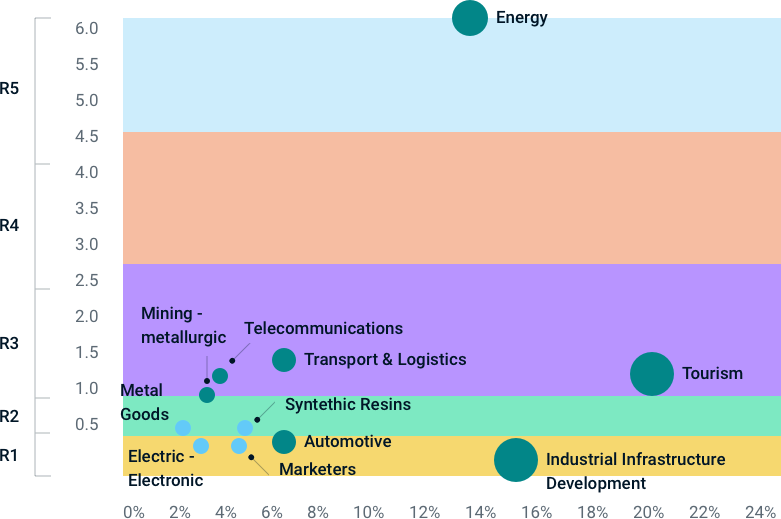
A good credit quality has been maintained with a balance structure for credits rated as R1-R3*, which exceeds 89%

*Internal Methodology

The Credit VaR in relation to the Company Portfolio decreased from 5.3% to 3.7% during 2012-2016 due to a decreased portfolio concentration and a lower propensity for deterioration in the transition matrix. The above resulted in a lower Unexpected Loss (Credit Economic Assets).


The most important Strategic Portfolios in regards to balance participation were Tourism (20.0%), Industrial Infrastructure Development (15.6%) and Energy (11.6%). Those exhibiting a lower risk were Industrial Infrastructure Development (R1), Automotive (R2), Telecommunications (R3) and Tourism (R3).
DEC 2016
The risk of the Money Desk position is low, since the portfolio is composed of variable rate and discount government instruments.



The position of derivatives with business purposes is composed by the sale to clients and purchase of hedges, over interest rate options (Caps), which is closed, and by rate swaps where a fixed rate differential is obtained.
Mark-to-Market
| Trading Derivatives (million pesos) | Short Position | Long Position | Total | Net Premiums | Hedging |
| Rate Options | -6.6 | 6.6 | 0.0 | 2.4 | Economic |
| Currency Options | 0.0 | 0.0 | 0.0 | 0.0 | |
| Total Trading Derivatives | -6.6 | 6.6 | 0.0 | 2.4 |
Mark-to-Market
| Trade Swaps (million pesos) | Receivable | Payable | Total | Credit line | Hedging |
| Interest Rate Swaps Client | 992.5 | 823.7 | 168.8 | 557.9 | Economic |
| Interest Rate Swaps Bank | 823.7 | 923.9 | -100.2 | ||
| Total Trade Swaps | 1,816.2 | 1,747.6 | 68.6 |
Integral Risk Dashboard
Credit
| Business | Credit | Market | Liquidity | Non-Discretionary |
| Type of Risk | ||||
| Strategic Sectors | Low | — | — | Low |
| Other Sectors | Medium | — | — | Low |
| Discount | Low | — | — | Low |
| Letters of Credit | Medium | — | — | Low |
| Guarantees | Medium | — | — | Low |
| Other Lines of Business | Low | — | — | Low |
| Subtotal Credit | Low | — | — | Low |
Markets & Liquidity
| Derivatives and Changes | Low | Low | — | Low |
| Money Desk | Low | Low | — | Low |
| Inv. Foreign Currency | Low | Low | — | Low |
| Inv. National Currency | Low | Low | — | Low |
| Liquidity | Low | Very Low | Medium | Low |
| Subtotal Markets and Liquidity | Low | Very Low | Medium | Low |
| Type of Risk Rating | Low | Very Low | Medium | Low |
| Final Rating | B | Low | ||
The total balance of the credit portfolio
Composition of Total Portfolio (million pesos)
In the private sector, financing totaled 225.43 billion pesos, which implies a 15.6% increase in real terms.
The induced total issued by BANCOMEXT in 2016, including collateral guarantees, guarantees and letters of credit, increased by 7% in real terms, climbing from 37.33 to 41.15 billion pesos, while the credit total issued via Financial Intermediaries rose from 18.21 to 25.26 billion pesos, which represents a 34.2% increase in real terms.

Composition of Peso-denominated Portfolio (million pesos)
Composition of Foreign Currency Portfolio (million pesos)
Contribution of strategic sectors to the number of Private Companies benefited in 1st Tier (million pesos)
The first-tier portfolio balance in the private sector increased by 16.89%, climbing from 143.72 billion pesos in 2015 to 167.9 billion pesos in 2016 (including fully funded letters of credit).
Contribution of strategic sectors to the number of Private Companies benefited in 1st Tier (million pesos)
The number of companies benefited exhibited a 5% increase, climbing from 1,216 in 2015 (725 companies assisted indirectly) to 1,278 in 2016 (which includes 787 companies assisted indirectly).

+
Benefiting Companies
Funding implied a total influx of 11.93 billion pesos offered to 981 companies.

Mejora Tu Hotel
BANCOMEXT, in partnership with the commercial banking sector, implemented the “Mejora Tu Hotel” (“Improve Your Hotel”) program with the objective of modernizing the hotel infrastructure, which was announced in April of 2016; 11 Commercial Banks participated in this initiative.
During 2016, assistance of BANCOMEXT in the tourism sector totaled a portfolio balance of 33.44 billion pesos, benefiting over 1,800 companies. Funding implied a total influx of 11.93 billion pesos offered to 981 companies.
From January through December of 2016, construction of 1,887 new hotel units was completed in 7 of the country’s states. The new hotel units added as part of finished projects resulted in the creation of 2,200 new direct, permanent, long-term jobs, with an estimated 5,000 additional indirect jobs.
By the end of 2016, the portfolio for this sector holds a total of 14 projects in the construction stage that are to begin operations in 2017. These projects represent 3,570 new hotel units which are expected to contribute to the creation of 4,300 direct, long-term jobs once completed.
BANCOMEXT, in partnership with the commercial banking sector, implemented the “Mejora Tu Hotel” (“Improve Your Hotel”) program with the objective of modernizing the hotel infrastructure, which was announced in April of 2016; 11 Commercial Banks participated in this initiative.
First-Tier Assistance
This program provides assistance to the sector through commercial banks with credits of up to 60 million pesos, at competitive interest rates, maturity periods that allow for an adequate growth of investment projects, but for the most part supported by BANCOMEXT. In addition, credits in excess of 60 million pesos rely on BANCOMEXT as a First-Tier lender. By the end of 2016, a total of 43 credits amounting up to 1.02 billion pesos were approved via the “Mejora Tu Hotel” Program for projects in 19 of the country’s states.
Assistance via the Guarantees Program
The program aims to finance hotels (mostly small and medium-sized) in projects involving construction; equipment; expansion; remodeling; technological and environmental improvements; and energy, fuel and water savings in the hotel; as well as any complete improvement of the facilities and/or services offered therein.
Benefiting Companies
BANCOMEXT continued participating in the development of Industrial Infrastructure, with investment vehicles funded with resources of Mexican AFORES (Retirement Fund Administrators) through Certificates of Capital Development (CKDs), an instrument that channeled the savings of Mexican workers into productive projects, resulting in the generation of development areas, and increased yields and resources for the retirement funds.
Benefiting Companies
BANCOMEXT continues to foster the inclusion of more Mexican companies in the value chain of the automotive sector, aiming to increase national value, increasing labor while supporting the growth of the national economy.
BANCOMEXT continues to foster the inclusion of more Mexican companies in the value chain of the automotive sector, aiming to increase national value, increasing labor while supporting the growth of the national economy.
In this regard, the most important operation this year in this subsector was the financing issued for 100 million dollars to complement the requirements for the construction of a tire manufacturing plant in San Luis Potosí, for a total investment of 550 million dollars, which will contribute to the generation of up to 800 direct, and 4,000 indirect jobs.
Our efforts in 2016 allowed the institution to rank as the second Bank in the Mexican Financial System in terms of financing offered to companies involved in this activity.
The total climbed to 9.38 billion pesos and increased by an 8% in relation to total amounted in 2015, which was 8.61 billion pesos. In 2016, the total resources allocated to this sector amounted up to 8.7 billion pesos, benefiting 44 companies.
The “PROAUTO” automotive industry supplier assistance program issued second-tier financing for 1.34 million pesos, benefiting 195 companies. 9 banks are taking part of this program.
The “PROAUTO” automotive industry supplier assistance program issued second-tier financing for 1.34 million pesos, benefiting 195 companies. 9 banks are taking part of this program.
As part of the integral automotive sector support strategy by the Federal Government, and with the purpose of assisting in the development of SMEs which are part of this sector’s global export supply chain, “PROAUTO” was announced in December of 2014 – a financing plan that offers special interest and maturity conditions through the Securities Program.
In October of 2016, the Internal Credit Committee of BANCOMEXT authorized the beginning of the second stage of the program after receiving additional resources from the INADEM in the form of counter guarantee funds for this stage. Since the beginning of the program until the end of 2016, the total issuance exhibited by the plan through commercial banks amounted up to 1.34 billion pesos, benefiting 195 companies.
Benefiting Companies
Bancomext finances projects involving the generation of clean energy (wind, solar photovoltaic panels, small hydro and cogeneration plants), as well as energy efficiency projects that aim to generate, by 2024, 25% using technologies such as these at competitive prices.
Bancomext finances projects involving the generation of clean energy (wind, solar photovoltaic panels, small hydro and cogeneration plants), as well as energy efficiency projects that aim to generate, by 2024, 25% using technologies such as these at competitive prices.
During 2016, BANCOMEXT took measures to collaborate with priority strategies of the Federal Government, in particular those related to the implementation of the energy reform, by participating in projects involving development, construction and implementation, as well as projects involving mid to long-term investment in this sector.
Assistance offered to this sector by the Institution is the second highest in the first-tier private sector portfolio –26.05 billion pesos– evidencing a 38% growth in relation to the 2015 first-tier private sector portfolio, and adding up to 15.5% of the total balance. Placements amounted up to 16.87 million pesos –48% higher than 2015–, which added up to 13% of the total first-tier placement total. 39 companies were benefited in this sector, which included the commissioning of the largest petrochemical industry project in Latin America, with an investment in excess of 4.4 billion dollars.
Furthermore, letters of credit were issued to assist in the bidding process and construction of the 520 km Laguna-Aguascalientes Gas Pipeline, as well as the 395 km Aguascalientes-Guadalajara Gas Pipeline, for a total investment in excess of 1.3 billion dollars, which are expected to be completed by 2018. Financing was granted for a project involving the reduction of leaks in transmission pipelines in the State of Mexico by means of the installation of “smart gauges”, for a total investment of 220 million dollars, and to be completed by 2017. In addition, two wind energy projects were commissioned in 2016 in the State of Nuevo León, with a rated capacity of 126 MW each, and involving an investment of over 300 million dollars.
Benefiting Companies
BANCOMEXT consolidated its presence in the Logistics, Transportation and Aircraft-Aerospace sectors, diversifying the portfolio by incorporating new clients from their various subsectors: land, sea, air, inventory financing and development of logistics infrastructure.
BANCOMEXT consolidated its presence in the Logistics, Transportation and Aircraft-Aerospace sectors, diversifying the portfolio by incorporating new clients from their various subsectors: land, sea, air, inventory financing and development of logistics infrastructure.
Financial support was channeled to most major airlines in the country, in addition to a regional airline, for the purpose of modernizing and/or updating their fleet, mostly in the form of PDPs (Pre-Delivery Payments), for a portfolio total of 2.74 billion pesos. As a result, BANCOMEXT continues to encourage aerial connectivity and the opening of new flight routes to national and international destinations. In addition, support was provided with the purpose of strengthening port infrastructure and foreign trade traffic, with the launch of a multipurpose loading terminal project in Tuxpan, Veracruz, turning it into a major logistics hub that is expected to facilitate the distribution of products and goods.
By the end of 2016, assistance offered to this sector exhibited an increase in the portfolio total of 14.5%, climbing from 8.49 billion pesos in 2015 to 9.73 billion pesos in 2016, which implied a 5.8% slice of the first-tier private sector portfolio, which benefited 29 companies. As for placements, this sector’s portfolio generated the highest first-tier resource contribution, amounting up to 27.6% for a total of 35.73 billion pesos and a 34% growth in relation to the same period of 2015.
By means of the inventory financing program, assistance for this sector showed a significant increase, climbing from a portfolio total of 298.6 million pesos by the end of 2015 to 757.3 million pesos by December 31st, 2016. This financing is composed of repo operations with the participation of bonded warehouses (Almacenes Generales de Depósito). In 2016, total placements in a year by means of this method climbed to 1.2 billion pesos.

Benefiting Companies
BANCOMEXT continued to solidify its actions to support the Telecommunications Reform undertaken by the Federal Government, supporting companies that provide Information and Communication Technology services (including broadband), telecommunications and radio broadcast to benefit the entire population.
BANCOMEXT continued to solidify its actions to support the Telecommunications Reform undertaken by the Federal Government, supporting companies that provide Information and Communication Technology services (including broadband), telecommunications and radio broadcast to benefit the entire population.
By the end of 2016, assistance offered to this sector showed a first-tier private sector portfolio total of 6.61 billion pesos, a 15% increase in relation to 2015 end-of-year numbers, and a resource allocation of 146 million pesos, benefiting 4 companies.
Benefiting Companies
Bancomext’s “Sector-Product-Geography” Business Model involves the participation of Regional Offices as a means to promote financial support for, and grant financial support to, all other sectors of the economy that are related to foreign trade and the generation of an influx of foreign currency.
Bancomext’s “Sector-Product-Geography” Business Model involves the participation of Regional Offices as a means to promote financial support for, and grant financial support to, all other sectors of the economy that are related to foreign trade and the generation of an influx of foreign currency.
The portfolio total for this sector amounted up to 51.32 billion pesos, which is a 30.5% of the first-tier private sector portfolio total. Allocation of financial resources climbed to 49.32 billion pesos and benefited 150 companies.

BANCOMEXT promoted the Letters of Credit service for clients with qualifying lines of credit and/or who opt for fully funded Letters of Credit, offering advice regarding the issuance of letters of credit requested and the corresponding follow-up until completion.
BANCOMEXT promoted the Letters of Credit service for clients with qualifying lines of credit and/or who opt for fully funded Letters of Credit, offering advice regarding the issuance of letters of credit requested and the corresponding follow-up until completion.
In 2016, the issuance of letters of credit to first-tier private sector companies with qualifying lines of credit added up to 6.98 billion pesos, which represented a 17% increase in relation to those which were issued in 2015, which totaled 5.97 billion pesos. In addition, operations involving fully funded letters of credit totaled 2.74 billion pesos. The strategy of offering operations with maturity periods in excess of one year, the efforts undertaken in infrastructure operations in the energy sector, and mid-term operations –or those that involve automatic annual renewals– have enabled us to ensure the continuity of the balance for upcoming years. During 2016, letters of credit issued to first-tier private sector companies with qualifying lines of credit amounted up to 5.71 billion pesos, and a total of 2.33 billion pesos resulted from operations involving fully funded letters of credit. The number of letter of credit operations was 621, driven by a higher quantity of operations by recurring clients.
A 29% growth was attained in financial stimulus products, for a total of 57.17 billion pesos.
The aforestated was accomplished thanks to a large network of national bank and non-bank financial intermediaries, with products specialized in foreign trade through the correspondent banking network, and exporting SME and major corporation relationship tools. By means of the following value offers:
Financing was granted to over 4,000 small and medium-sized exporting companies participating in foreign trade and activities that generate an influx of foreign currency (PyMEx); a figure that comprises 90% of the total of companies assisted by BANCOMEXT.
| PRODUCTS | 2013 | 2014 | 2015 | 2016 |
| Guarantees | 1,775 | 3,273 | 2,688 | 3,714 |
| Funding | 279 | 297 | 447 | 538 |
| Factoring | 126 | 135 | 176 | 210 |
| TOTAL PYMEX | 2,180 | 3,705 | 3,311 | 4,462 |

Intermediaries
Benefiting Companies
BANCOMEXT has strengthened its strategy of encouraging financing for foreign trade and activities that generate an influx of foreign currency by providing resources to bank and non-bank financial intermediaries for them to, in turn, offer loans to companies that have operations in international markets or that generate an influx of foreign currency. This funding focuses mainly on small and medium-sized banks with medium and long-term operations.
The balance of the Financial Intermediary Funding Program has exhibited a 39% growth, climbing from 18.2 billion pesos recorded by the end of 2015, to 25.26 billion pesos in December of 2016, offering assistance to a total of 538 companies in 2016.
Balance for the program
Intermediaries
Benefiting Companies
An intense promotion of the Guarantees Program was undertaken in 2016, which has reflected on its results. 2016 figures show that 3,714 companies have been offered assistance, which have procured financing under the best conditions through the Exporting and Importing SME Support Program and the Tourism Sector Support Program. This assistance has been provided through 14 financial intermediary banks.
The Guarantees Program exhibited a balance of 15.82 billion pesos by December 31st, 2016, which represented an 18% increase in relation to the 2015 end-of-year balance, when a total balance of 13.39 billion pesos was recorded.
International
Benefiting Companies
The International Factoring Program offers Mexican exporting companies (including those which do not have access to traditional financing) risk coverage, management of accounts receivable, collection and financing services. Additionally, the program offers assistance to Mexican importing companies for importing products and services from foreign countries.
The aforementioned program registered placements for 9.12 billion pesos, assisting 210 companies in obtaining almost immediate liquidity over their foreign accounts receivable via two platforms: FCI International Factoring and PrimeRevenue International Factoring.
Over 17,000 invoices from 32 countries were financed through the FCI platform.
Suppliers
Balance for the program
Empresas apoyadas
During the second half of 2014, operations began for the Supplier Factoring Program in collaboration with the Office of the Deputy Director General of Corporate Banking. This program enables BANCOMEXT to finance accounts receivable of companies that supply major exporting companies (EPOs / First-Tier Companies).
December 2016 figures show a balance of 1.94 billion pesos which were used to assist a total of 194 companies which supply 304 related companies.
34 counterparty risk lines are in operation. 60% of operations are with highly prestigious banks.
As a result of BANCOMEXT’s strategy to be repositioned as a supplier of this service, and the constant promotion carried out targeting international banks, by December 31st, 2016, a total balance of 13.15 billion pesos was registered in Letters of Credit with National and International Banks.
Worth a special mention is the diversification achieved in terms of operation sources, since at the time we have 97 qualifying counterparty risk lines (34 in service) with international banks in 29 countries. Over 60% of operations related to this product are performed with banks that hold a high prestige, which allows BANCOMEXT to have the certainty that its international counterparts will perform.
Three online training courses were held in 2016; records show 50 users signed up to the platform and personalized service was rendered to 60 companies
During 2015 the first phase of the Financial Technical Assistance Program took place, which offers exporting SMEs tools to mitigate financial risks, facilitating their integration to foreign trade value chains, the diversification of their markets and an increased presence in the global environment:
Courses developed during 2016:
BANCOMEXT participated in over 26 events such as the federal and state launch of the “Mejora tu Hotel” (“Improve your Hotel”) program in collaboration with SECTUR (Tourism Secretariat), as well as the “Pacific Alliance Forum” and the “National Entrepreneur Week,” among others.
Strategic alliances with other organisms and institutions, both in the public and the private sector, have been a key medium to advertise BANCOMEXT’s Programs and Services for small and medium-sized exporting companies.
During 2016 we took part in over 26 different events which have enabled us to obtain feedback in regards to the need for assistance and financial services of the exporting and importing community, in addition to promoting BANCOMEXT’s products and services. In this regard, the collaboration with SECTUR in the federal and state launch of the “Mejora tu Hotel” program deserves a special mention, as do many other events such as the “Pacific Alliance Forum” and the “National Entrepreneur Week,” among others.
Business strategies and market opportunities yielded positive results for BANCOMEXT.

Revenues
In the face of global financial conditions, Treasury and Financial Markets generated revenues of 1.78 billion pesos as a result of strategies to take advantage of opportunities in market operations, manage the balance, manage investment portfolios according to profit criteria, perform arbitrage operations and use allocated capital effectively, within the boundaries of credit risk, market and liquidity.
Business strategies and market opportunities yielded positive results for BANCOMEXT, generating revenues of 1.78 billion pesos.
In the face of global financial conditions, Treasury and Financial Markets generated revenues of 1.78 billion pesos as a result of strategies to take advantage of opportunities in market operations, manage the balance, manage investment portfolios according to profit criteria, perform arbitrage operations and use allocated capital effectively, within the boundaries of credit risk, market and liquidity.
BANCOMEXT helps companies cover their market risks through the sale of derivatives.
Operations with clients are targeted at first-tier companies that have market risks associated with exchange and/or interest rates.
BANCOMEXT addressed its clients’ investment needs by means of deposits in dollars for an average monthly amount of 1.9 billion dollars.
BANCOMEXT obtained guarantees from Export Credit Agencies (ECAs), which reduced interest rates for clients, as well as their credit risk.
BANCOMEXT’s premise has been to provide the business sector convenient financial conditions for their projects, and positioning of their business incursions in international markets. Totals by December, 2016 are as follows: Multilateral 120 million pesos, Bilateral 6.58 billion pesos, and ECA Guarantees 135 million pesos.
Lines of credit were provided for financing medium and long- term sustainable projects.
BANCOMEXT’s international activities include over 31 active lines for an approximate available total of 6 billion dollars. Bilateral lines of credit have been negotiated for supporting renewable and sustainable energy projects with competitive financial conditions.
BANCOMEXT positioned itself at the forefront of Development Banks by issuing TIER II subordinated debt in international markets.
A bond (TIER II Nonconvertible Subordinated Note) was issued on international markets for a total of 700 million dollars with a 10-year maturity. This strengthens the capital adequacy ratio in the face of exchange rate fluctuations, taking it from 12.4% to approximately 19.6%, which allows for continued financing of the country’s foreign trade and participation in the promotion of said activity.
By making use of derivatives, BANCOMEXT covers balance risks by means of:
A Specialized Office was created for Developing and Promoting Investment Projects in order to Attract Long-Term Capitals.
The construction of infrastructure and the modernization of existing one are key factors in the country’s development. In August of 2016, at the request of the SHCP (Mexican Secretariat of Finance and Public Credit) and pursuant to recommendations by the G20 and several international organizations, a specialized office was created within BANCOMEXT to help increase the offer of investment projects in various sectors, and to link those projects with domestic and international investors.
Activities of this office focus on:
This office aims to complement the actions of other bodies of the Federal Government and to combine efforts toward the incubation, relationship and advertising of investment opportunities.
Some of the office’s undertakings since August of 2016 were to perform an investment ecosystem analysis for the country in order to identify areas of opportunity where value can be added, taking into account all the stages of the project development cycle in each of the infrastructure sectors.
Overall, the office aims to gather all relevant information regarding each sector through an investment bank.
During the 2016 August-December period, the office worked on the following courses of action:
Portal’s Identity Definition:

A system for the addition of information was developed, as well as the design of the structure of a WEB system for project promotion.
Relationships were established with information suppliers, assigning a link for each of the sources.
Information was received from several sources; it was reviewed and reflected on the system.
Among the relationships established with various Sources, we can mention:
Information exchange methods were defined in conjunction with the organizations. One example is the information provided by Compranet, indicating us a direct link to project documentation published by this organization within its portal.
The methods for loading projects, publishing and follow-up were designed, where the information of each of the published projects was verified with several sources of information.
Business rules were set forth for the development of a Customer Relationship Manager (CRM) that will pair projects with investors based on their preferences and areas of interest, as well as for information control.
A test version of the Portal in Spanish and English was ready by the end of 2016, which encompasses the following sections:
Why Mexico?
with 67 updatable datasets
How to Invest
in 11 infrastructure sectors which provide relevant data and information for the investor to make better decisions and be able to learn about both processes and institutions of the country.
Knowledge bank
With documentation focused on the development of PPP projects (with 110 links to documents of interest). It is worth mentioning that basic PPP and infrastructure financing guides were developed in-house.
Projects
such as the main section of the portal which displays all investment projects in a standardized manner organized into three major groups: New Projects, Ongoing Projects and Investor Relationships.
Regarding promotion of the Platform
The project was shared with over 30 stakeholders (investment funds, banks, consultants and law firms) and 8 multilateral organisms with very positive feedback both nationally and internationally.
Meetings were held with the main multilateral organisms with the purpose of analyzing the feasibility of receiving technical assistance and incorporate them as strategic allies:
We proposed the creation of a sociedad anónima de propósito especial (Mexican special-purpose corporation) with the purpose of complementing the offer of assistance for the performance of pre-investment studies.
Talks begun with federal offices interested in implementing PPP projects in the short term:
Pursuant to adapting to the needs arising from an ever-changing environment, BANCOMEXT works comprehensively toward adjusting and improving its practices.

The implementation of an Environmental and Social Risk Management System allows for the evaluation of credit operations that influence the portfolio and prestige of BANCOMEXT.
Pursuant to adapting to the needs arising from an ever-changing environment, BANCOMEXT works comprehensively toward adjusting and improving its practices. The implementation of an Environmental and Social Risk Management System allows for the evaluation of credit operations that influence the portfolio and prestige of BANCOMEXT. Expectations for this System include: Identifying, evaluating and managing E&S risks generated by clients while performing their activities and projects to be financed, so that the possibilities of assuming transferred costs and impact to their reputation are minimized; reducing risks that may be posed by a borrower in relation to payment capabilities and by the value of borrower guarantees resulting from the impact of regulatory penalties and market share loss; considering the necessary actions for documentation monitoring and recordkeeping; monitoring compliance with E&S regulations applicable to its borrowers; demanding compliance by prospective borrowers with mitigation measures with the purpose of identifying E&S risks; identifying opportunities among new products that involve E&S aspects; setting forth actions that enable it to improve its reputation among its clients, investors and other stakeholders, and to exercise a continuous improvement, considering mainly identified risks, company classification and the impact in credit rating.
Being the main driver of commerce development through innovation and quality demands people who are committed and guided by shared values, ethics and principles.

Gender Equity
With a staff of 554 employees, 56% of which are male and 44% female, BANCOMEXT carries out its mission of encouraging the financing of foreign trade and the generation of an influx of foreign currency toward the country.

Training
Committed with the constant enrichment of its personnel, it undergoes approximately 1,431 hours of training per month at Bancomext. This, because efficient performance of the duties in any position requires constant updating efforts. In order to attend to this need, Bancomext grants education loans and organizes events to enrich the daily experience of all employees. Currently, 94% of employees have a Bachelor's Degree, while 25% have a Master’s Degree and 1% have a PhD. Furthermore, BANCOMEXT has a social services program with the purpose of teaching theoretical and practical knowledge to young people, which currently has 82 students.
Comercio Exterior BANCOMEXT is a quarterly publication of Banco Nacional de Comercio Exterior, S.N.C. whose first issue was launched in 1951. The origin of this Magazine arose from the Institution’s commitment to the dissemination of information about major national and international economic and commercial events. Each issue is dedicated to a specific current event related to the external sector and is composed of an analysis section, specialized articles written by persons of renown within the field of the subject matter, a section dedicated to Mexico, and another one dealing with the international environment. Comercio Exterior is a specialized channel of information for all companies and individuals who are interested in learning at a theoretical and practical level the opportunities of international commerce and the potential of our country in order to take advantage of the development of the external sector.
Moody’s, Standard & Poor’s and Fitch credit rating agencies rate BANCOMEXT as shown below, with consideration to the robustness of the Institution and the backing the Federal Government provides it with toward the fulfilment of its goal of being a driver of Foreign trade development in Mexico. On August 23rd, 2016, the Standard and Poor’s rating agency changed BANCOMEXT’s outlook rating from Stable to Negative, in line with the change in outlook for the Federal Government. On June 30 th, Moody’s downgraded the rating of BANCOMEXT’s secured senior debt (stand alone) by one level to ba3. Likewise, on December 15th of 2016, the Fitch rating agency changed BANCOMEXT’s outlook from Stable to Negative, also in line with the Federal Government’s rating.
Moody’s Investors Service (moodys.com.mx)
| 1 | Outlook | Negative |
| 2 |
Long Term Rating Baseline Credito Assessment |
A3 ba3 |
| 3 | Short Term | P-2 |
| Standard & Poor’s (www.standardandpoors.com.mx) | ||
| 4 | Outlook | Negative |
| 5 | Issuer Credit FC LT | BBB+ |
| 6 | Issuer Credit FC ST | A-2 |
| Standard & Poor’s National (www.standardandpoors.com.mx) | ||
| 7 | Natl LT Issuer Credit | mxAAA |
| 8 | Natl ST Issuer Credit | mxA-1+ |
| Fitch Ratings (www.fitchmexico.com) | ||
| 9 | Outlook | Negative |
| 10 | Issuer default FC LT | BBB+ |
| 11 | Issuer default LC LT | A- |
| 12 | Issuer default FC ST | F2 |
| 13 | Issuer default LC ST | F2 |
| 14 | Support rating | 2 |
| Fitch National (www.fitchmexico.com) | ||
| 15 | Natl Long Term | AAA(mex) |
| 16 | Natl Sr Unsecured | AAA(mex) |
| 17 | Natl Short Term | F1+(mex) |
The Capital Adequacy Ratio as of December 31st, 2016 was 19.2%, and it was 12.7% by December 31st of 2015 – final figures approved by the Bank of Mexico.
2010-2016 Financial Index Comparison
| Indexes | 2010-2015 AVERAGE | 2016 December |
| 1. Capital Adequacy Ratio (CAR) | 13.6% | 19.2% |
| 2. Corporate Portfolio Growth | 34.1% | 19.0% |
| 3. Delinquency Rate (Delinquent Corporate Portfolio/Corporate Portfolio) | 1.4% | 1.3% |
| 4. Debt Coverage Ratio (Reserves/Delinquent Corporate Portfolio) | 282.1% | 187.0% |
| 5. Portfolio Concentration (GINI index) | 67.0% | 65.0% |
| 6. Return on Equity (ROE) | 6.8% | 3.1% |
| 7. Net Profit Margin (Net Profit/Total Income) | 10.0% | 6.2% |
| 8. Financial Margin Growth | 9.0% | 22.1% |
| 9. Financial Margin/Total Portfolio | 3.0% | 2.5% |
| 10. Efficiency Ratio (Operational Expenditure/Total Income) | 17.1% | 11.0% |
Notes:
Indexes 2 through 5 use Corporate Portfolio and Indexes 6 through 10 use total portfolio
Portfolio=Current Portfolio + Delinquent Portfolio
Income=Collected Income + Net Commissions + Brokerage
Corporate Portfolio Indexes
| Corporate Portfolio Indexes | Annual Average 2010-2015 | December 2016 |
| Corporate Portfolio (% Total Portfolio) | 73.8% | 73.5% |
| Corporate Portfolio (% Growth) | 34.1% | 16.5% |
| Delinquent Portfolio (Delinquency Rate) | 1.4% | 1.2% |
| Concentration (Gini Index) | 67% | 65% |
| Remaining Maturity (Years) | 4.3 | 4.7 |
|
Maturity (% Payment pending) ST (≤1 year) MT (1 to 3 years) LT (>3 years) |
17.0% 25.3% 57.7% |
13.2% 26.8% 60.0% |
|
Allocation (% Fixed Investment) (% Working Capital) |
78.4% 21.6% |
84.0% 16.0% |
|
Currency (% Foreign Currency) (% Domestic Currency) |
65.0% 35.0% |
73.1% 26.9% |